
01
Dynamics of light harvesting
Photosynthetic organisms utilize sophisticatedly constructed pigment–protein complexes to absorb sunlight and conduct energy to the reaction center with near-unity quantum efficiency. We aim to understand the molecular mechanisms that enable this extremely efficient process and to gain new insights that can improve artificial light-harvesting devices.
Here, we develop theories for excitation energy transfer that cover a broad parameter range and use molecular modeling to elucidate how the protein environment influences electronic excitations.

02
Photon-induced chemical dynamics
Photon-induced chemical dynamics are usually ultrafast, highly non-equilibrium, and nonadiabatic. This situation is far from the applicability of conventional Arrhenius dynamics, and it opens up tremendous opportunities for coherent control and novel chemical transformations.
We use mixed quantum-classical methods to study nonadiabatic chemical dynamics of molecular systems in highly constrained condensed-phase environments, such as in proteins and nanoreactors. The aim is to elucidate fundamental principles of chemical control of excited-state dynamics for new types of photochemistry.

03
Theory for ultrafast nonlinear spectroscopy
Time-resolved ultrafast spectroscopies are the main techniques for experimental investigations of molecular interactions and dynamics in the condensed phase. For example, recent optical nonlinear experiments have provided critical information on light harvesting in photosynthesis and ultrafast photochemistry in vision. Because of the complexity of these experiments, theoretical modeling and computer simulations are required to develop molecular-level descriptions of the underlying processes.
We develop new theoretical methods that enable the calculation of nonlinear spectra of molecular systems directly based on light-driven dynamics described by a quantum master equation formalism. Multidimensional electronic spectra for non-adiabatic systems evaluated in this way are valuable for guiding and interpreting experiments.

04
Multi-scale modeling of optoelectronic nano-materials
Photoactive molecular architectures have attracted intensive research interest in chemistry and nanoscience because of their potential to achieve extraordinary optoelectronic properties. Despite intensive research, the rational design of photoactive molecular materials is still very much under development. The main roadblock is the lack of a fundamental understanding of excitation energy transfer and charge transfer dynamics in these complex molecular systems.
A robust theoretical approach that predicts bulk optical and electronic properties of molecular materials, e.g., absorption spectra and charge-carrier mobilities, from the chemical structure of their molecular subunits entails multiple major challenges in theoretical chemistry. We develop multi-scale methodologies to simulate electronic dynamics in complex condensed-phase molecular systems with molecular detail, and apply them to investigate how molecular architectures and fluctuations affect electronic quantum dynamics in the condensed phase.
05
Quantum computing for chemistry
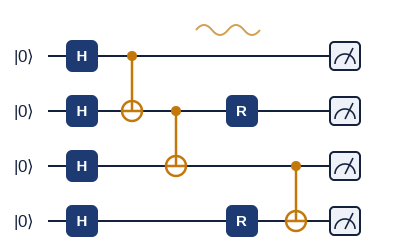
Quantum computers promise to tackle chemical problems that are out of reach for classical computers, but today’s devices are small and noisy. We develop quantum computational algorithms for solving chemical problems that can run within these constraints.
Current projects include efficient quantum simulation of open quantum system dynamics and dissipative energy transfer on noisy quantum computers, and accurate quantum computations of molecular properties, such as vibrational frequencies, using compact molecular-orbital representations. This work connects naturally with our theories of condensed-phase quantum dynamics.
Software
QDAS (Quantum Dynamics And Spectroscopy) is our code for simulating quantum dynamics of multilevel excitonic systems in the condensed phase and computing their linear and nonlinear spectra.